eBooks · ग्रन्थाः
Tulasī Vivāha and Tulasī Pūjā prayogas
Read them here after signing in with your email; no password is needed. The books cannot be printed or copied.

Shraddham and pitru karyam at Kashi, in person or on your behalf
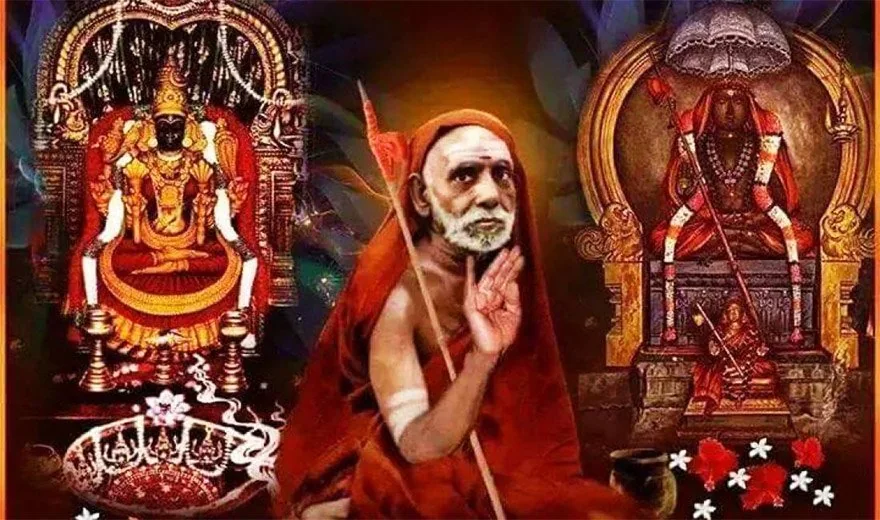
अपारकरुणासिन्धुं ज्ञानदं शान्तरूपिणम् ।
श्रीचन्द्रशेखरगुरुं प्रणमामि मुदाऽन्वहम् ॥
The Paramācārya of Kāñcī · 68th Śaṅkarācārya of the Kāñcī Kāmakoṭi Pīṭham · 1894–1994
We bow to the Paramācārya, the ocean of boundless compassion, whose whole life upheld the daily study of the Veda and the śāstras.
Each service opens at its own address.
eBooks · ग्रन्थाः
Read them here after signing in with your email; no password is needed. The books cannot be printed or copied.
Sign in with your admin email and the admin password to open the Booking desk and every office desk.
Kashi · काशी
Book in a few short steps. Our purohit calls you to confirm the date and the details.
Sankalpam · सङ्कल्पः
Choose the rite and the departed person's details. The sankalpam is worked out for the place, date and time, and can be copied for your purohit.
The full mahāsaṅkalpa with daśavidha snāna. The tithi, vāra, nakṣatras, yoga and karaṇa are filled in for Kāśī at the time you choose, shown in colour.
Shraddha Mahima · काशी
When there is no son or daughter, or no one in the family able to perform them, the Shraddham and the rites after death can still be done at Kashi. A learned Brahmin performs them on the family's behalf, in the departed person's name and gotram.
Kashi, also called Avimukta, is the city Lord Vishwanatha is said never to leave. The Skanda Purana's Kashi Khanda and the wider Puranic tradition count it among the most sacred places for rites to the ancestors. With Prayag and Gaya, it forms the Tristhali, the three teerthas traditionally visited for pitru karyam.
Tradition holds that a Shraddham done on the banks of the Ganga at Kashi, with tila, darbha and pindam, gives lasting satisfaction to the pitrus. It is believed to bring blessings of peace and continuity to the family that offers it. Many families make a once-in-a-lifetime Kashi Teertha Shraddham for all ancestors on both sides.
The Dharmashastras give an order of who may perform the rites. It begins with the son, then grandson and great-grandson, then the wife, daughter and daughter's son. After them come the brother, nephew and other relatives of the same line. Further down come the acharya, a disciple or a friend.
The tradition stresses that the rites should not be left undone. Where no one in that order is able to act, the family or a well-wisher may appoint a qualified Brahmin as pratinidhi (representative). He takes the sankalpam in the departed person's name and gotram and performs the rites in full. Tradition holds that the offerings reach the departed just the same.
Practices differ between families and sampradayams. Our purohits follow your family's tradition and will discuss it with you before the rite.
Choose them here and they are carried to the booking form when you press Book with a Brahmin karta.
Sadgatiḥ Bhavatu · Advance Sankalpa
Many elders wish to know that the rites after their time will be done properly at Kashi, without placing a burden on their children. With an Advance Sankalpa you choose the rites today and place a fixed deposit in the name of Kashi Anushtanam. When the time comes, your family only needs to inform us, and we perform every rite you chose, as promised in a written undertaking.
If someone who arranged an Advance Sankalpa with us has passed away, please accept our heartfelt condolences. Let us know here, or call 92774 15099 at any hour, and we will begin the rites they chose. The first rites are time-bound, so please inform us as early as you can.
Asthi by post · अस्थि विसर्जन
When the family cannot travel, you may send the asthi to us by post or courier. Our purohit receives it with reverence and performs Asthi Visarjanam in the Ganga at Kashi, with sankalpam in the departed's name and gotram, and sends you the video and photographs.
Sahāya · सहाय
If you hold a white ration card or your family's income is small, you can arrange your rites at Kashi through low-cost government insurance taken at your post office, with Kashi Anushtanam as nominee. When the time comes, we claim the insurance, perform the rites you chose, and pay the balance to your family.
Prāyaścitta for chronic diseases, from the Karmavipāka granthas and Āyurveda
The śāstras teach that some long illnesses are the fruit of past karma, and that prāyaścitta, dāna, japa and homa can lessen them. Our consultants study the patient's illness with the Karmavipāka texts (Madanamahārṇava, Vīrasiṃhāvaloka and Śātātapa's Karmavipāka) and the janma-kuṇḍalī, and an Āyurvedic vaidya looks at the illness itself. You then receive the parihāra suited to the patient.
Consultation fee, paid once: ₹2,500 · Please keep taking the treatment your doctor has advised.
Our office will check your payment and contact you with the details of the consultation call. A copy of your request has been emailed to you.
Gayā · गया
Piṇḍa pradānam at Gayā for the pitrus on both sides, by our purohits: for one day, three days, or the full order of the Tristhalīsetu.
The Tristhalīsetu calls Gayā Śrāddha a son's duty: by offering piṇḍas at Gayā he is freed from his debt to the pitrus. Once is enough, and repeating it adds to the merit.
Tristhalīsetu, p. 40
Tristhalīsetu, pp. 36–40; Tīrthenduśekhara, pp. 55–59
Prayāga · प्रयागः
Tīrtha Śrāddha at the Triveṇī saṅgama, with muṇḍana for the karta and Veṇī-dāna for sumaṅgalīs, by our purohits.
Pūjās · पूजाः
Pūjās performed at Kāśī by our purohits, with you in person, or on your behalf with sankalpam in your names.
Each pūjā follows a written prayoga, with the deśa-kāla of Kāśī for the day. Sign in with your email to read it on this site.
Tristhalī · त्रिस्थली
The three tīrthas traditionally visited for pitru karyam, in one yātrā. Our purohits perform the Tīrtha Śrāddha at all three.
We follow the Tristhalīsetu of Bhaṭṭoji Dīkṣita, the standard digest on this yātrā, with Nāgeśa Bhaṭṭa's Tīrthenduśekhara. Both explain who may go, how to set out, and what is done at each tīrtha.
For families from the South, the Tristhalīsetu sets the order Prayāga, then Kāśī, then Gayā. A separate sankalpa is taken for each: at home for Prayāga, at Prayāga for Kāśī, and at Kāśī for Gayā.
Tristhalīsetu, pp. 1–40; Tīrthenduśekhara, pp. 55–59 (Saraswati Bhavana Texts 65–67, Benares 1936)
Requests you sent from this account, with their latest status from the office.
All online and offline requests. Update status after calling the karta.